(caveat: please credit the author for anything used from this page (Bill R McEachen))
4/28/2023 After asking Google's Bard, it replied "...Based on the Cramér conjecture, we can estimate that the next Mersenne prime will have an exponent of around 248620489....". Via https://t5k.org/notes/faq/NextMersenne.html, 1.47576*82589933 ~ 121882919 is another exponent "prediction".
12/31/2018 well, latest MP exponent is 82589933 (earlier than my predicted). My next "prediction" is exponent = 110687989. Ref: https://www.i-programmer.info/news/112-theory/12412-a-new-mersenne-prime-discovery.html
1/5/2018 well, latest MP exponent is 77232917. My next "prediction" is exponent = 84926213 - 85869036 ie 84900000 - 85900000 (about 55K candidates). see OEIS A113656
start say at 84926249
1/2016 well, latest MP exponent is 74207281 (recall my stab at prediction was range 59E6 and 64.3E6 below ). I'll try to update for the next "prediction".
2/2014 primorial approximation: ln(Y)= x^2/102+4.35x -30.4 for x>19, thru x~81 (within 1.6% accuracy)
or ln(Y)~ x^2/(23Q) + Qx -7*Q
ex. actual ln(66#)=300, approx. 299.43 [generally ln(Y) is proportional to x^2/51, 4x ]
as more points are fit, C2 decreases, C1 increases, C0 decreases
A235399 pari code
(8)need look: A38569, ,A57000,A145605,A130046,A64520,A62329,A46675,A5590
Jan 24 2014 charts: A228446, A230546, A233654, A6577, A135141, A234520,
Noe: A38569, ,A57000,A68396,A138472, A145605,A130046, A64520, A2260, A62329, A46675, A132213, A5590, A125688,
other (look): A64413, A2618, A18900, A5245, A6666, A5132, A6577, A141095, A80738, A76217, A99302, A48601,
mine: A226095
Nov 8 I may submit a seq relating to A135076
Nov 3 2013 submitted seq 231115 relating to A083849
A 83844 3.0+ ?? only 25 terms; sumdigits(987)=24 PARI
Oct 26 2013 my newest OEIS sequence A228446 stemming from a conjecture of ZW Sun (odd #=prime + x(x+1) )...Cf A046927. Its log plot is very appealing, and I subsequently found Sun's A230546 sequence plot similarly interesting ...I also just learned of Ming-Zhi Zhang's conjecture (OEIS A036468) that any odd number greater than one can be written as x + y (x, y > 0) with (x^2 + y^2) prime. Eg 2^2+5^2=29, and 7=2+5.
Sep 11 2013 I came across this via OEIS A000040 (the prime numbers)
I conjecture that Sum(1/(p(i)*log(p(i))))=Pi/2=1.570796327... Sum_{i=1..100000}(1/(p(i)*log(p(i))))=1.565585514... It converges very slowly. - Miklos Kristof, Feb 12 2007
May 28 2013 I submitted OEIS A226095, primes formed from specific concatenation of integers>2. Good volatility and multiplicative effect. For hit rate, let n=5000000, and Primepi~ 331281. The alg script IDs 559290 primes in 5000000 integer evals (ie primality tests), for 559290/5000000=11.2%. This count is above 331281, a good number of them are >5000000, so it is superior when one can accept non-sequential primes and wants them bigger than smaller. The maximum gap between primes thru n=5000000 follows: gap=9.882*ln(x) -38.8. Very unlikely for sequence to be finite.
Feb 8 2013 rumor is a new Mersenne Prime is found (exp=57885161 which is 17,425,170 digits long). I will update my next prediction when time permits (my last one was 43581437 < XX < 121000000). See wikipedia for more info. Using the last 15 pts, the next MP exponent is forecast in range 59E6 and 64.3E6, though it could be much higher. Digits stem from exp/2.3026, so this corresponds to a range to 19.4 million digits.
Nov 4 I just came across A134204 and its beautiful plot supplied by TD Noe at 
(http://www.sspectra.com/math/A134204.png)
Oct 27 2012 I submitted draft OEIS sequence 218391 relating to a property distinguishing composites and primes (the orig observation is someone else's)
Jul 2011 I did a bit of scrutiny and added comment for OEIS A084639. Here is more detail: OEIS A084639
Feb 16 2011 I submitted a sequence related to Mersenne numbers today to OEIS. It relates to factors having the form k*n+1 where MN=2^n-1 (A186283). I can provide Pari script. Thru the first 200 MN, the composites yield ~90% for the form shown. This merely says you are well served to try that specific divisor form before further brute force. I also submitted the dual form (A185343). This topic relates to factoring work I am doing (in my limited spare time).
Feb 13 2011 I note the Lagarias seq is A057641, which is a favorite of Peter Luschny, whose website includes among other things info on computation of factorials.
I sent errata list on David Wells book to Wiley
Feb 2011 I note the earlier link given for George Spencer-Brown is dead, the only stub is
http://laws-of-form.net/lof/ which has a phone contact. I retain his method and Primepi estimates in a Google spreadsheet. I revisit this because of reading David Wells' Prime Numbers. I always learn something, and learned about Chris Nash's proof concerning the algebraic sum of primes below any number N>17.
Dec 2010 been making a few observations and fixes relating to primes at OEIS,Wikipedia, etc
June 9 2009 likely new Mersenne Prime found (exp. 42643801). After refitting, the next "predicted" exponent ~ 43581437 (the 48th Mersenne Prime, presuming no gaps). The last 5 or 6 are closely bunched (?) [or if we bring all back in line from the bunching, the next exp could be as large as 121000000 ! ]
Feb 13 2009 I submitted a sequence to OEIS today, here is the data file associated. typical loglog curve newseq.gnumeric
It is formed by treating the nonzero digits from ratio of adjacent integers >0 ignoring repeating decimals. So we use 1/2, 3/4, 4/5, to yield scaled as digits 5,75,8, etc. It is a nice infinite, diverging sequence that is pretty volatile term-by-term.
All but the 3rd entry contains a 5 or 9 digit. The log fit (to the log data) is shown on the chart. Here is the plot of the first 160 terms:
http://commons.wikimedia.org/wiki/File:OEIS_A156703.svg
Feb 11 2009 I had the comment from someone that my last sequence seemed a bit contrived due to the nature of where the Bernoulli Numbers are found/defined. I must offer that there would be MANY sequences that could fall into a contrived category before mine, which I would argue is no contrivance. It merely lays out the Twin Primes which are encountered (we know they will be) but the manner and final plot of that encounter is certainly not known apriori.
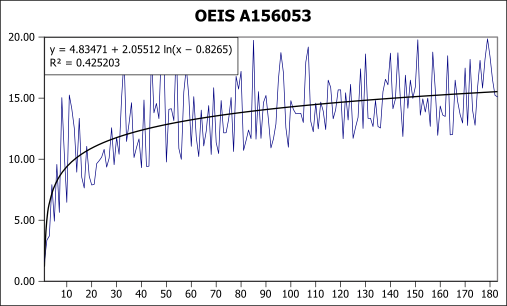
Feb 6 2009 add latest sequence A156053. I have added the image to WikiCommons upload.wikimedia.org/wikipedia/commons/e/eb/OEIS_A156053.svg
Nov 19 2008 list my main OEIS sequences: A117825,A129912,A077287,A102648,A128910,A147517,A113972,A156053 see http://www.research.att.com/~njas/sequences/
A129912 relates to my main PPP conjecture (primes as f{primorials,primorial products}
A147517 relates to the symmetrical primes as a f{A002110, primorials}. Very limited terms, may relate to A025218 ( via floor(log(*)) ie floor(log(82116003))=18 so A025218(n)= floor(log(a(n+2))
A147853 is a spinoff of A147517 and relates to Goldbach partitions of 2*primorials (A002110), providing very spread Goldbach pairs
A117825 relates to distance from HCN and nearest prime (relates to GC, my HCN conjecture, Fortune's conjecture) this has an interesting pinplot
A077287 concerns a mechanism that generates a lot of prime numbers with very volatile numeric spread (see OEIS scatterplot)
A102648 is just a nice function to generate an interesting spread of values (it is a simple mechanism to quickly generate prime numbers from a fixed range of small integer seeds in a fairly arbitrary way...(see OEIS pinplot))
this version generates values <=20 but this range is dependent on the gain (100) used
A128910 is a tweaked form of the Prime Counting Function (better at range of N many users work with)
A113972 a form I derived that yields an interesting sequence of primes, with many hi/lo transitions
A156053 shows the Twin Primes (lower of pair) encountered by the Bernoulli Number denominators. Excl duplicates, thru first 15000 BN
A172069 relates the adjacency of primes to entries of A129912
A265436 **
Sep 16 2008 see http://www.mersenne.org/m45and46.htm for info on the 2 new Mersenne Primes
the exponents are 37,156,667 and 43,112,609, for the 45th and 46th Mersenne Primes. These surpass the 10 million digit threshold. After refitting, the next "predicted" exponent ~ 49,318,327 (the 47th Mersenne Prime).
Aug 24 2008 speak more to C Rivera's Conjecture#47
Aug 1st 2008 add Google translate widget
Riemann's Hypothesis
after reading __Music of the Primes__,
re: Lagarias equivalent to Riemann's Hypothesis (An Elementary Problem Equivalent to the Riemann Hypothesis, Jeffrey Lagarias 2002)
I believe an equivalent is
exp(AQ)< exp(H)ln(H) for ln(sigma)~ A*Q +B
where B<=ln(2), A<=1 required (strictly)
H=harmonic# N and Q=harmonic # (N/2)
for N>=7207200, the (0 intercept) slopes ln(sigma)/Q seem to be <1 ie
due to B>0, lower N can accomodate
observation shows that ln(sigma)/Q can increase or decrease with increasing N
- - - -
Inefficient Primality methods
the Pari code for an optimized Wilson Theorem primeness function soon -limited time, so put near-optimized here:$
Harrell's original code is in UBASIC, and had limit of N=6053 in that application, I do not confirm his modification is useful
here is the Pari code for implementing Willans formula for assessing primeness: willans.gp
I am working on Pari implementation of Harrell's ubasic code for Prime Producing Equation, will post when done$$PEND
= = = =
Arbitrary Large primes (200 digit+)
I am working a bit on producing an arbitrary large prime of desired size within Pari. My method appears to work well compared to the "quadratic residue" method I've seen (P^2-2 where P=user-selected odd prime)
I will post more here quad3.gp besides the script, requires the script to generate A2110: a(n)=prod(j=1,n,prime(j)) , expanding primelimit and allocating enough memory
- an interesting site re: prime producing polynomials much beyond the classic n^2-n+41 types:
http://www.prime-equations.com/index.html by a Mr Hank Harrell
= = = =
Mersenne Primes
using a simple fit from the 1st 44 Mersenne Prime exponents, the 45th comes in circa 8.6E7. We'll see ...the fit is log(MPE)=A*(MP posn)^B R^2=0.99+,(A,B)=(0.1712,0.2310)
= = =
Prime Counting Function (Jun 2 2008 see Spencer-Brown note farther down)
a quick&dirty approx (3 signif digits only) is as follows:
nval=K*N/lnN where K~1.022
ex. n=1E15 returns # primes ~29.6E12
these estimates will be within 1% of actual. Of course, Riemann's pcf is more accurate with a bit more work. the above eq'n is OEIS seq A128910
= = = =
Open Problems
Here are a few links to Open Problems in Math (also see Wikipedia)
see also http://garden.irmacs.sfu.ca/?q=category/number_theory_0
= = = =
May 28 2008 much along lines of Harrell's work, came across a different site which to me is very interesting, akin to Ulam's spiral but more involved it would seem ...I provide the link here (Mr Robert Sacks) http://www.numberspiral.com/index.html
= = = =
I came across George Spencer-Brown's Prime Limit Theorem web discourse and it works xtremely well. It is a much better approx than Li(x)
the link is http://laws-of-form.net/lof/pdf/PrimeLimitTheorem.pdf
I can offer a short spreadsheet in Google docs as requested ...
I realize my nice plot of PCF on Wikipedia was deleted, so here it is back (I will add in GSB data shortly):
Pcf_plot9.xls
This contrasts Riemann,Li(x) etc
= = = =
I came across this basic conjecture: http://www.primepuzzles.net/conjectures/conj_047.htm
essentially it says P=3P1+2P2 where P are all prime numbers
Now, this is of interest, as it allows one to produce a larger prime from 2 smaller ones, in a seemingly very predictable way.
Here is the Pari script to run solutions out: conj47.gp
I MUST give credit to Charles Greathouse for assisting me in finding script bugs
As of today 8/22, it reported first "failure" at 33112, NOT of the conjecture but of my twist on it, that wondered whether the alg solns are "closed" in that every new prime result depends ONLY on the orig seeds {3,5,7,11,13,17} and previous primes produced (working thru the conjecture in ascending order of (P1+P2) sums, which are just Goldbach partitions. HOWEVER, I believe the script is reporting a false Failure, as there are many GP solns using primes in the set. $$PEND to resolve, it may be a sizing issue, as that output is 1007598 lines long ...
links to my other math pages:
main Twin Primes and Goldbach's Conjecture Highly Composite Numbers (conjecture)


Comments (0)
You don't have permission to comment on this page.